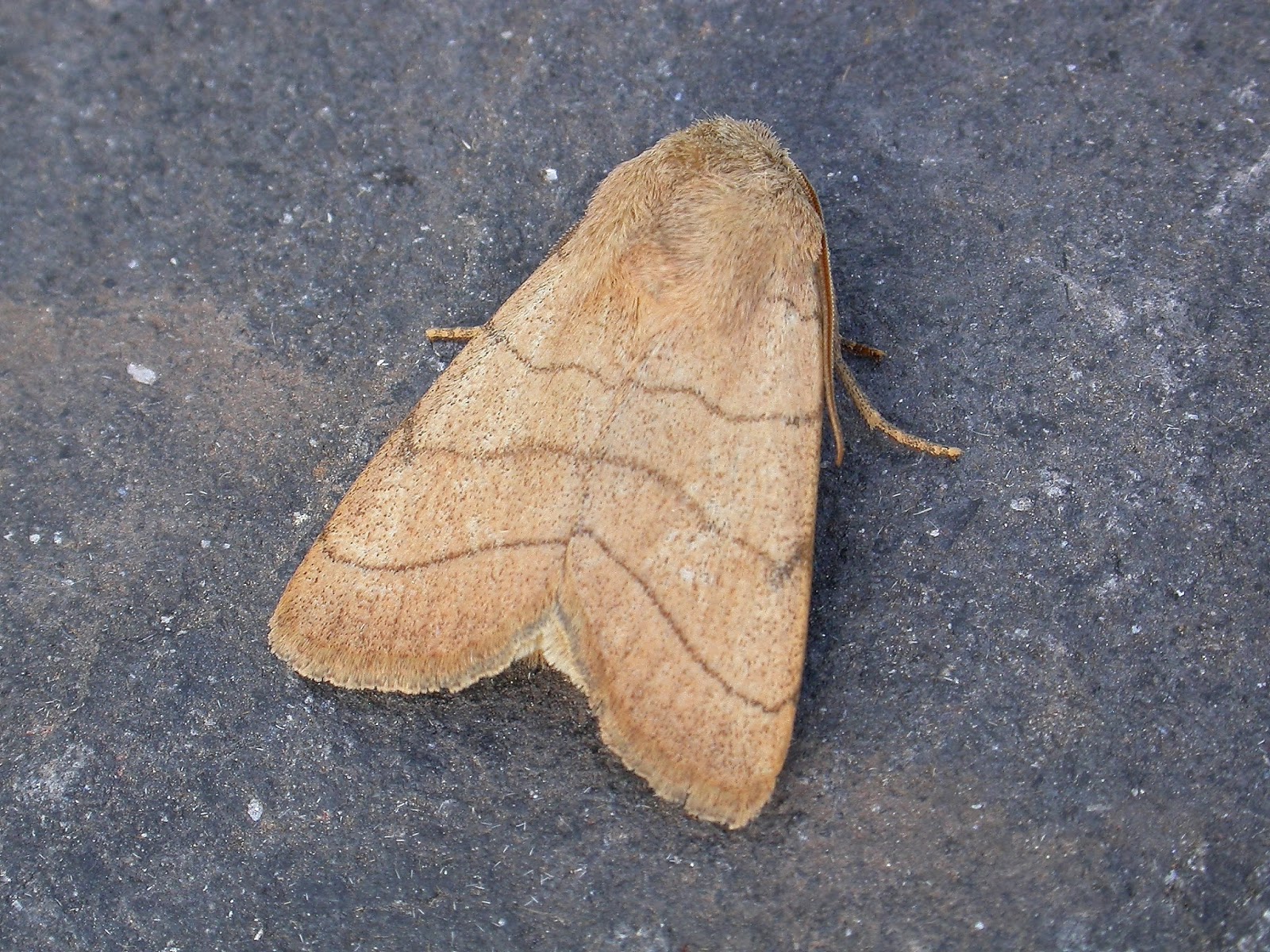
2325 Apamea oblongana - Crescent Striped

Status: Rare wanderer.
Habitat/Food plant: A species inhabiting salt marshes, estuary's and mud flats ... the larval food plants are the roost and stems of various grasses,
Broods/flight period: Single brooded, flying from late June into August.
1999 - 2024 garden records: One record, taken on 24th July 2013.
Earliest date: n/a.
Latest date: n/a.
Peak count: n/a.
2326 Apamea crenata - Clouded-bordered Brindle

Status: Rare wanderer.
Habitat/Food plant: Grasslands, woodland rides, Fens etc, the larval food plants are various grasses, including Cock's-foot.
Broods/flight period: Single brooded, flying from late May into July.
1999 - 2025 garden records: Four records here, on 14th June 2002, 31st May 2003, 27th May 2008 and 29th May 2025.
Earliest date: 27th May 2008.
Latest date: 14th June 2002.
Peak count: Singles only.
2327 Apamea epomidion - Clouded Brindle

Status: Scarce, though increasing in Thanet during the mid to late 2000's.
Habitat/Food plant: Broadleaved Woodland, Parkland etc. The larval food plants are various grasses including Cock's-foot.
Broods/flight period: Single brooded, flying in June and July.
1999 - 2024 garden records: It took many years before I caught one here, nine years to be precise. Up till 2015 I took seven specimens, arriving all as singles, on 11th June 2007, 8th June 2008, 13th June 2009, 15th June 2009, 24th June 2012, 21st June 2014 and 14th June 2015.
2007 = 1. 2008 = 1. 2009 = 2. 2010 = 0. 2011 = 0. 2012 = 1, 2013 = 0. 2014 = 1. 2015 = 1. 2016 = 1. 2017 = 1. 2018 = 0. 2019 = 0. 2020 = 0. 2021 = 1. 2022 = 0.
2023 = 0. 2024 = 0.
Earliest date: 8th June 2008.
Latest date: 24th June 2012.
Peak count: Singles only.
2330 Apamea remissa - Dusky Brocade


Status: Regular in small numbers.
Habitat/Food plant: Grassy places, open woodland etc.
Broods/flight period: Single brooded flying mostly in late May and June.
1999 - 2024 garden records: The population was fairly stable here throughout my earlier years of running moth traps though it became awfully scarce from 2015/16 onward ... the totals being:
2017 = 6. 2018 = 4. 2019 = 8. 2020 = 8. 2021 = 4. 2022 = 3. 2023 = 1. 2024 = 0.
Earliest date: 22nd May 2007.
Latest date: July 21st 2000.
Peak count: 5 moths, one night in June 2005.
2331 Apamea unanimis - Small Clouded Brindle

Status: Scarce.
Habitat/Food plant: Marshes, ponds, Fens, damp open woodland etc. The larval food plants are grasses including Reed Canary-grass and Wavy Hair Grass.
Broods/flight period: Single brooded, flying in May and June.
1999 - 2024 garden records: The are always of note here, recorded on only ten occasions and in only six of the seventeen years that I've been running the garden moth traps, once in 2001, twice in 2003, twice in 2007, twice in 2009 then once in 2014, 2015 and 2017.
Status: Rare wanderer.
Habitat/Food plant: Rough grassland, woodland rides, marshes etc. The larvae feed upon various grasses.
Broods/flight period: Single brooded, on the wing from late July through to September.
1999 - 2024 garden records: Just the one moth ever here, taken on 26th July 2010.
Earliest date: n/a.
Latest date: n/a.
Peak count: n/a.
2361 Hydacecia micacea - Rosy Rustic

Status: Regular in small numbers.
Habitat/Food plant: Wide ranging, occurring in gardens, wooded areas, hedgerows, marshes etc. The larvae are not too fussy about what they eat with Dock, Plantain, Field Woundwort, Sea Lavender, Potato, cultivated Strawberry, Burdock, Horsetail (the plant, not the rear end equine protuberance) and Yellow Iris etc amongst the many things munched upon by the caterpillar stage.
Broods/flight period: Single brooded, flying from August to October.
1999 - 2024 garden records: The population was once reasonably stable here, the latter years though it has shown a steep decline. The last few years tally being;
Earliest date: 8th June 2008.
Latest date: 24th June 2012.
Peak count: Singles only.
2330 Apamea remissa - Dusky Brocade

Above: The three usual morphs of this species ...
Status: Regular in small numbers.
Habitat/Food plant: Grassy places, open woodland etc.
Broods/flight period: Single brooded flying mostly in late May and June.
1999 - 2024 garden records: The population was fairly stable here throughout my earlier years of running moth traps though it became awfully scarce from 2015/16 onward ... the totals being:
2017 = 6. 2018 = 4. 2019 = 8. 2020 = 8. 2021 = 4. 2022 = 3. 2023 = 1. 2024 = 0.
Earliest date: 22nd May 2007.
Latest date: July 21st 2000.
Peak count: 5 moths, one night in June 2005.
2331 Apamea unanimis - Small Clouded Brindle
Status: Scarce.
Habitat/Food plant: Marshes, ponds, Fens, damp open woodland etc. The larval food plants are grasses including Reed Canary-grass and Wavy Hair Grass.
Broods/flight period: Single brooded, flying in May and June.
1999 - 2024 garden records: The are always of note here, recorded on only ten occasions and in only six of the seventeen years that I've been running the garden moth traps, once in 2001, twice in 2003, twice in 2007, twice in 2009 then once in 2014, 2015 and 2017.
2018 = 0. 2019 = 0. 2020 = 2. 2021 = 5. 2022 = 1. 2023 = 1. 2024 = 1.
Earliest date: 17th May 2007.
Latest date: 22nd June 2003.
Peak count: 2 on 12th June 2021.
2333 Apamea anceps - Large Nutmeg

Status: Scarce, but increasing. A very recent addition to the resident moths of Thanet.
Habitat/Food plant: They inhabit calcareous grassland, the larvae feed on Common Couch, Cock's-foot and Cereal crops.
Broods/flight period: Single brooded, on the wing in June and July.
1999 - 2024 garden records: They started to arrive on the Thanet moth scene in the late 2000's, up till then they had been a scarce wandering moth into the area. It took me until June 2012 to catch one here but gradually, year upon year, they have became a low level annual visitor.
the annual totals have been/were:
2012 = 2. 2013 = 1. 2014 = 2. 2015 = 0. 2016 = ? 2017 = 1. 2018 = 4. 2019 = 5. 2020 = 9. 2021 = 21. 2022 = 22. 2023 = 38. 2024 = 23.
Earliest date: 17th May 2022 and 2024.
Latest date: 2nd July 2013.
Peak count: 5 on 10th June 2023.
2334 Apamea sordens - Rustic Shoulder-knot


Status: Common/regular in small numbers.
Habitat/Food plant: Grasslands, Farm land etc. The larval food plants are various grasses such as Common Couch, Cock's foot etc. They will also feed on cereal crops.
Broods/flight period: Single brooded, flying from May to June/July.
1999 - 2024 garden records: Numbers have increased here since the middle 2000's.
Earliest date: 22nd April 2014.
Latest date: 22nd July 2013.
Peak count: A maximum of six on various dates.
2335 Apamea Scolopopacina - Slender Brindle

Status: Scarce wanderer.
Habitat/Food plant: A moth chiefly of woodland where the larvae feed on various woodland grasses such as Wood Melick, Wood Meadow-grass and False Broom.
Broods/flight period: Single brooded, flying from late June till middle August.
1999 - 2026 garden records: Seven records here, on 29th June 2001, 14th July 2004, 20th July 2006, 1st August 2008, 3rd August 2008, 19th July 2022 and 28th June 2026.
Earliest date: 28th June 2026.
Latest date: 3rd August 2008.
Peak count: Singles only.
2336 Apamea ophiogramma - Double-lobed

Status: Scarce.
Habitat/Food plant: Damp places, marshes, River banks, Lake Margins and damp woodland. The larval stage feeds on Reed Canary-grass, Reed Sweet-grass and cultivated Pampas Grass.
Broods/flight period: Single brooded, flying in July and August.
1999 - 2024 garden records: There have been only 7 records here.
The annual totals have been:
1999 = 0. 2000 = 0. 2001 = 0. 2002 = 0. 2003 = 0. 2004 = 1. 2005 = 0. 2006 = 2. 2007 = 1. 2008 = 1. 2009 = 1. 2010 = 0. 2011 = 1. 2012 = 0.
2013 = 0. 2014 = 0. 2015 = 0. 2016 = 0. 2017 = 0. 2018 = 0. 2019 = 0. 2020 = 1. 2021 = 0. 2022 = 0. 2023 = 0. 2024 = 0.
Earliest date: 27th June 2011.
Latest date: 26th July 2009.
Peak count: Singles only.
2337 Oglia strigilis - Marbled Minor

Status: Common.
Habitat/Food plant: A wide range of grasslands where the larvae feed on Common Couch, Cocks-foot and Reed Canary-grass etc.
Broods/flight period: Single brooded, flying from late May to July.
1999 - 2024 garden records: Common, though perhaps slightly less so that they used to be?
Earliest date: 11th May 2007.
Latest date: 13th July 2015.
Peak count: 27 moths, taken on 15th June 2004.
2339 Oglia latruncula - Tawny Marbled Minor

Status: Common.
Habitat/Food plant: A wide range of grasslands where the larvae feed on Cocks-foot and other grasses.
Broods/flight period: Single brooded, flying from late May to late July.
1999 - 2024 garden records: Common, perhaps slightly on the increase here?
Earliest date: 7th May 2007.
Latest date: 7th August 2007.
Peak count: 26 moths, taken in single nights in 2004, 2005 and 2011.
2340 Oglia fasciancula - Middle-barred Minor

Status: Almost annual and always in very small numbers.
Habitat/Food plant: damp grasslands, woodland rides, marshes etc. The larval food plants are various grasses, particularly Tufted Hair-grass.
Broods/flight period: Single brooded, flying mainly in June and July.
1999 - 2024 garden records: Only ever recorded as singletons here ... the annual tallies have been:
1999 = 0. 2000 = 0. 2001 = 2. 2002 = 4. 2003 = 9. 2004 = 2. 2005 = 5. 2006 = 2. 2007 = 0. 2008 = 2. 2009 = 3. 2010 = 3. 2011 = 0. 2012 = 2.
2013 = 1. 2014 = 2. 2015 = 1. 2016 = 2. 2017 = 2. 2018 = 0. 2019 = 0. 2020 = 4. 2021 = 1. 2022 = 7. 2023 = 7. 2024 = 1.
Earliest date: 27th May 2017.
Latest date: 2nd August 2005.
Peak count: With it being highly unusual to get more than one in any one night here so 3 moths taken on 3rd July 2003 was exceptional. Every other record over the twenty year period has been made up of single moths before a mad hot period in mid June of 2022 turned up a crazy 5 on the 17th then 2 more on the 18th.
2341 Mesoligia furuncula - Cloaked Minor


Status: Common.
Habitat/Food plant: Open areas of grassland, coastal sand dunes, cliffs, chalk downland etc. The food plants are various grasses.
Broods/flight period: Single brooded, on the wing in June though to September.
1999 - 2024 garden records:
Earliest date: 3rd June 2008.
Latest date: 20th August 2015.
Peak count: 12 moths, one night in 2013. .
2342 Mesoligia literosa - Rosy Minor

Status: Borderline notable, not quite annual.
Habitat/Food plant: Various open calcareous areas such as cliffs, grass land, sand dunes etc. The larval food plants are various grasses and even cereal crops.
Broods/flight period: Single brooded, flying in July and August.
1999 - 2024 garden records: The annual totals were as follows:
1999 = 2. 2000 = 0. 2001 = 0. 2002 = 3. 2003 = 4. 2004 =1 . 2005 = 2. 2006 = 1. 2007 = 1. 2008 = 3. 2009 = 2. 2010 = 0. 2011 = 2. 2012 = 0.
2013 = 1. 2014 = 1. 2015 = 1. 2016 = 0. 2017 = 1. 2018 = 1. 2019 = 3. 2020 = 1. 2021 = 2. 2022 = 3. 2023 = 0. 2024 = 1.
Earliest date: 11th July 2009. .
Latest date: 27th August 2005.
Peak count: Singles only.
2343 Mesapamea secalis - Common Rustic


Status: Common.
Habitat/Food plant: Wide ranging, the larvae feed on various grasses.
Broods/flight period: One generation, on the wing from June till September.
1999 - 2024 garden records:
Earliest date: 19th June 2014.
Latest date: 19th September 2000.
Peak count: Many counts in the 40's and 50's here, also 67 on 28th July 2004 and 82 one night in 2013.
2343a Mesapamea didyma - Lesser Common Rustic

Status: Not sure ... certainly annual.
Habitat/Food plant: Wide ranging, the larvae feed on various grasses.
Broods/flight period: Single brooded, on the wing in July and August.
Earliest date: 30th June 2004.
Latest date: 8th September 2012.
Peak count: A maximum count of about 3.
2345 Photedes minima - Small Dotted Buff

Status: Rare wanderer.
Habitat/Food plant: Damp grassland and marshland, the larval food plant is Tufted Hair Grass.
Broods/flight period: Single brooded, flying from late June till early August.
1999 - 2024 garden records: Two records here, both as singles seen on 13th July 2010 and 19th July 2022.
Earliest date: . n/a.
Latest date: n/a.
Peak count: n/a.
2347 Chortodes extrema - Concolorous

Status: Rare migrant.
Habitat/Food plant: Damp marshy areas amongst ancient woodland. The larval food plants are Purple Small-reed and Woody Small-reed.
Broods/flight period: Single brooded, flying from May till July.
1999 - 2024 garden records: A red data book species in the U.K. restricted to a few colonies amongst the ancient woodlands in Huntingdonshire, Northamptonshire and Buckinghamshire so I would presume that my capture would be a continental migrant, especially so seeing as Franny caught one in his Thanet traps the night prior ...
[I was later told by you know who, i.e. the all knowing FS, that they have bred in Stone Lees in the past and still may do? I will leave the previous drivel as it was originally written, just to show what an utter know-nothing clot I am.]
Three records, taken on 25th May 2014, 28th May 2014 and 10th June 2023.
Earliest date: 25th May 2014.
Latest date: 10th June 2023.
Peak count: singles only.
2349 Chortodes fluxa - Mere Wainscot

Status: Rare wanderer.
Habitat/Food plant: Damp woodland rides, marshes, reed beds and ditches etc. The larval food plant is Wood Small-reed.
Broods/flight period: Single brooded, on the wing in July and August.
1999 - 2024 garden records: single moths were recorded on: 9th July 2008, 13th July 2009, 26th July 2013, 11th July 2014, 13th July 2014, 14th August 2017, 12th July 2018 and 30th July 2022.
Earliest date: n/a..
Latest date: n/a.
Peak count: n/a.
2350 Chortodes pygmina - Small Wainscot


Status: Rare wanderer.
Habitat/Food plant: Fens and Marshland where the larvae feed on a few species of Sedge ... also Reed and possibly Rushes?
Broods/flight period: Single brooded, flying in August and September.
1999 - 2024 garden records: Three records. The first I found already dead in one of moth traps on 25th August 2011 then a second on ??? (can't find date. I forgot to record it! I think it was August 2017?) then a third on 25th July 2019.
Earliest date: n/a.
Latest date: n/a.
Peak count: n/a.
2352 Eremobia ochroleuca - Dusky Sallow

Status: Annual ... or thereabouts.
Habitat/Food plant: Grassy places, the larval stage feeds on the flowers and seeds of grasses such as Cock's-foot, False Oat Grass and Common Couch. It will eat Cereal crops too.
Broods/flight period: Single brooded, on the wing in July and August.
1999 - 2024 garden records: My annual catch-rate chart reads thus:
1999 = 0. 2000 = 0. 2001 = 1. 2002 = 1. 2003 = 6. 2004 = 0. 2005 = 3. 2006 = 4. 2007 = 1. 2008 = 4. 2009 = 9. 2010 = 7. 2011 = 1. 2012 = 1.
2013 = 4. 2014 = 3. 2015 = 4. 2016 = 6. 2017 = 2. 2018 = 8. 2019 = 6. 2020 = 15. 2021 = 5. 2022 = 13. 2023 = 12. 2024 = 18.
Earliest date: 5th July 2018.
Latest date: 21st August 2012.
Peak count: 3 moths, one night in July 2009.
2353 Luperina testacea - Flounced Rustic

Status: Common.
Habitat/Food plant: A wide range of gassy places as well as arable fields and woodland rides. Most frequent around calcareous soils apparently, of which the 'vile Isle' (i.e. Thanet) itself sits upon!
Broods/flight period: Single brooded, flying mainly during August and September/early October.
1999 - 2024 garden records: A common moth of late summer/early autumn here, with many catches into double figures and upwards.
Earliest date: 20th July 2003 and 2014.
Latest date: 12th October 2001.
Peak count: 46 moths, one night in 2011.
2358 Amphipoea fucosa - Saltern Ear


Status: rare wanderer.
Habitat/Food plant: A moth of salt marsh and sand dunes. The larval food plant is unstated (so presumably not known?) but they are known to eat the stems and roots of grasses in captivity.
Broods/flight period: Single brooded, flying in August and September.
1999 - 2024 garden records: Ten records here: 1 on 13th August 2001, 1 on 4th August 2003, 1 on 7th August 2013, 11th August 2013 and 23rd July 2016 then 3 singles between 16th and 20th July 2022 and singles on 4th and 6th August 2023. 1st August 2024.
Earliest date: 16th July 2022.
Latest date: 11th August 2013.
Peak count: singles only.
2360 Amphipoea oculea - Ear Moth

Earliest date: 17th May 2007.
Latest date: 22nd June 2003.
Peak count: 2 on 12th June 2021.
2333 Apamea anceps - Large Nutmeg
Status: Scarce, but increasing. A very recent addition to the resident moths of Thanet.
Habitat/Food plant: They inhabit calcareous grassland, the larvae feed on Common Couch, Cock's-foot and Cereal crops.
Broods/flight period: Single brooded, on the wing in June and July.
1999 - 2024 garden records: They started to arrive on the Thanet moth scene in the late 2000's, up till then they had been a scarce wandering moth into the area. It took me until June 2012 to catch one here but gradually, year upon year, they have became a low level annual visitor.
the annual totals have been/were:
2012 = 2. 2013 = 1. 2014 = 2. 2015 = 0. 2016 = ? 2017 = 1. 2018 = 4. 2019 = 5. 2020 = 9. 2021 = 21. 2022 = 22. 2023 = 38. 2024 = 23.
Earliest date: 17th May 2022 and 2024.
Latest date: 2nd July 2013.
Peak count: 5 on 10th June 2023.
2334 Apamea sordens - Rustic Shoulder-knot
Above: The three colour forms of this species.
Status: Common/regular in small numbers.
Habitat/Food plant: Grasslands, Farm land etc. The larval food plants are various grasses such as Common Couch, Cock's foot etc. They will also feed on cereal crops.
Broods/flight period: Single brooded, flying from May to June/July.
1999 - 2024 garden records: Numbers have increased here since the middle 2000's.
Earliest date: 22nd April 2014.
Latest date: 22nd July 2013.
Peak count: A maximum of six on various dates.
2335 Apamea Scolopopacina - Slender Brindle
Status: Scarce wanderer.
Habitat/Food plant: A moth chiefly of woodland where the larvae feed on various woodland grasses such as Wood Melick, Wood Meadow-grass and False Broom.
Broods/flight period: Single brooded, flying from late June till middle August.
1999 - 2026 garden records: Seven records here, on 29th June 2001, 14th July 2004, 20th July 2006, 1st August 2008, 3rd August 2008, 19th July 2022 and 28th June 2026.
Earliest date: 28th June 2026.
Latest date: 3rd August 2008.
Peak count: Singles only.
2336 Apamea ophiogramma - Double-lobed
Status: Scarce.
Habitat/Food plant: Damp places, marshes, River banks, Lake Margins and damp woodland. The larval stage feeds on Reed Canary-grass, Reed Sweet-grass and cultivated Pampas Grass.
Broods/flight period: Single brooded, flying in July and August.
1999 - 2024 garden records: There have been only 7 records here.
The annual totals have been:
1999 = 0. 2000 = 0. 2001 = 0. 2002 = 0. 2003 = 0. 2004 = 1. 2005 = 0. 2006 = 2. 2007 = 1. 2008 = 1. 2009 = 1. 2010 = 0. 2011 = 1. 2012 = 0.
2013 = 0. 2014 = 0. 2015 = 0. 2016 = 0. 2017 = 0. 2018 = 0. 2019 = 0. 2020 = 1. 2021 = 0. 2022 = 0. 2023 = 0. 2024 = 0.
Earliest date: 27th June 2011.
Latest date: 26th July 2009.
Peak count: Singles only.
2337 Oglia strigilis - Marbled Minor
Status: Common.
Habitat/Food plant: A wide range of grasslands where the larvae feed on Common Couch, Cocks-foot and Reed Canary-grass etc.
Broods/flight period: Single brooded, flying from late May to July.
1999 - 2024 garden records: Common, though perhaps slightly less so that they used to be?
Earliest date: 11th May 2007.
Latest date: 13th July 2015.
Peak count: 27 moths, taken on 15th June 2004.
2339 Oglia latruncula - Tawny Marbled Minor
Status: Common.
Habitat/Food plant: A wide range of grasslands where the larvae feed on Cocks-foot and other grasses.
Broods/flight period: Single brooded, flying from late May to late July.
1999 - 2024 garden records: Common, perhaps slightly on the increase here?
Earliest date: 7th May 2007.
Latest date: 7th August 2007.
Peak count: 26 moths, taken in single nights in 2004, 2005 and 2011.
2340 Oglia fasciancula - Middle-barred Minor
Status: Almost annual and always in very small numbers.
Habitat/Food plant: damp grasslands, woodland rides, marshes etc. The larval food plants are various grasses, particularly Tufted Hair-grass.
Broods/flight period: Single brooded, flying mainly in June and July.
1999 - 2024 garden records: Only ever recorded as singletons here ... the annual tallies have been:
1999 = 0. 2000 = 0. 2001 = 2. 2002 = 4. 2003 = 9. 2004 = 2. 2005 = 5. 2006 = 2. 2007 = 0. 2008 = 2. 2009 = 3. 2010 = 3. 2011 = 0. 2012 = 2.
2013 = 1. 2014 = 2. 2015 = 1. 2016 = 2. 2017 = 2. 2018 = 0. 2019 = 0. 2020 = 4. 2021 = 1. 2022 = 7. 2023 = 7. 2024 = 1.
Earliest date: 27th May 2017.
Latest date: 2nd August 2005.
Peak count: With it being highly unusual to get more than one in any one night here so 3 moths taken on 3rd July 2003 was exceptional. Every other record over the twenty year period has been made up of single moths before a mad hot period in mid June of 2022 turned up a crazy 5 on the 17th then 2 more on the 18th.
2341 Mesoligia furuncula - Cloaked Minor
Above: This species is highly variable, with perhaps ten different types/plumages on offer
Status: Common.
Habitat/Food plant: Open areas of grassland, coastal sand dunes, cliffs, chalk downland etc. The food plants are various grasses.
Broods/flight period: Single brooded, on the wing in June though to September.
1999 - 2024 garden records:
Earliest date: 3rd June 2008.
Latest date: 20th August 2015.
Peak count: 12 moths, one night in 2013. .
2342 Mesoligia literosa - Rosy Minor
Status: Borderline notable, not quite annual.
Habitat/Food plant: Various open calcareous areas such as cliffs, grass land, sand dunes etc. The larval food plants are various grasses and even cereal crops.
Broods/flight period: Single brooded, flying in July and August.
1999 - 2024 garden records: The annual totals were as follows:
1999 = 2. 2000 = 0. 2001 = 0. 2002 = 3. 2003 = 4. 2004 =1 . 2005 = 2. 2006 = 1. 2007 = 1. 2008 = 3. 2009 = 2. 2010 = 0. 2011 = 2. 2012 = 0.
2013 = 1. 2014 = 1. 2015 = 1. 2016 = 0. 2017 = 1. 2018 = 1. 2019 = 3. 2020 = 1. 2021 = 2. 2022 = 3. 2023 = 0. 2024 = 1.
Earliest date: 11th July 2009. .
Latest date: 27th August 2005.
Peak count: Singles only.
2343 Mesapamea secalis - Common Rustic
Status: Common.
Habitat/Food plant: Wide ranging, the larvae feed on various grasses.
Broods/flight period: One generation, on the wing from June till September.
1999 - 2024 garden records:
Earliest date: 19th June 2014.
Latest date: 19th September 2000.
Peak count: Many counts in the 40's and 50's here, also 67 on 28th July 2004 and 82 one night in 2013.
2343a Mesapamea didyma - Lesser Common Rustic
This black with very white stigma type doesn't occur amongst the many and varied the M. secalis form apparently.
Status: Not sure ... certainly annual.
Habitat/Food plant: Wide ranging, the larvae feed on various grasses.
Broods/flight period: Single brooded, on the wing in July and August.
1999 - 2024 garden records: Due to some of their number being very similar to the previous species (Common Rustic) and therefore only definitely identifying the extremes and i.e. 'obvious' specimens, both their status and proper numbers remain a mystery. Examination of the genitalia with use of a microscope is the only sure way to separate some from Common Rustics.
Earliest date: 30th June 2004.
Latest date: 8th September 2012.
Peak count: A maximum count of about 3.
2345 Photedes minima - Small Dotted Buff
Status: Rare wanderer.
Habitat/Food plant: Damp grassland and marshland, the larval food plant is Tufted Hair Grass.
Broods/flight period: Single brooded, flying from late June till early August.
1999 - 2024 garden records: Two records here, both as singles seen on 13th July 2010 and 19th July 2022.
Earliest date: . n/a.
Latest date: n/a.
Peak count: n/a.
2347 Chortodes extrema - Concolorous
Status: Rare migrant.
Habitat/Food plant: Damp marshy areas amongst ancient woodland. The larval food plants are Purple Small-reed and Woody Small-reed.
Broods/flight period: Single brooded, flying from May till July.
1999 - 2024 garden records: A red data book species in the U.K. restricted to a few colonies amongst the ancient woodlands in Huntingdonshire, Northamptonshire and Buckinghamshire so I would presume that my capture would be a continental migrant, especially so seeing as Franny caught one in his Thanet traps the night prior ...
[I was later told by you know who, i.e. the all knowing FS, that they have bred in Stone Lees in the past and still may do? I will leave the previous drivel as it was originally written, just to show what an utter know-nothing clot I am.]
Three records, taken on 25th May 2014, 28th May 2014 and 10th June 2023.
Earliest date: 25th May 2014.
Latest date: 10th June 2023.
Peak count: singles only.
2349 Chortodes fluxa - Mere Wainscot
Status: Rare wanderer.
Habitat/Food plant: Damp woodland rides, marshes, reed beds and ditches etc. The larval food plant is Wood Small-reed.
Broods/flight period: Single brooded, on the wing in July and August.
1999 - 2024 garden records: single moths were recorded on: 9th July 2008, 13th July 2009, 26th July 2013, 11th July 2014, 13th July 2014, 14th August 2017, 12th July 2018 and 30th July 2022.
Earliest date: n/a..
Latest date: n/a.
Peak count: n/a.
2350 Chortodes pygmina - Small Wainscot


Status: Rare wanderer.
Habitat/Food plant: Fens and Marshland where the larvae feed on a few species of Sedge ... also Reed and possibly Rushes?
Broods/flight period: Single brooded, flying in August and September.
1999 - 2024 garden records: Three records. The first I found already dead in one of moth traps on 25th August 2011 then a second on ??? (can't find date. I forgot to record it! I think it was August 2017?) then a third on 25th July 2019.
Earliest date: n/a.
Latest date: n/a.
Peak count: n/a.
2352 Eremobia ochroleuca - Dusky Sallow
Status: Annual ... or thereabouts.
Habitat/Food plant: Grassy places, the larval stage feeds on the flowers and seeds of grasses such as Cock's-foot, False Oat Grass and Common Couch. It will eat Cereal crops too.
Broods/flight period: Single brooded, on the wing in July and August.
1999 - 2024 garden records: My annual catch-rate chart reads thus:
1999 = 0. 2000 = 0. 2001 = 1. 2002 = 1. 2003 = 6. 2004 = 0. 2005 = 3. 2006 = 4. 2007 = 1. 2008 = 4. 2009 = 9. 2010 = 7. 2011 = 1. 2012 = 1.
2013 = 4. 2014 = 3. 2015 = 4. 2016 = 6. 2017 = 2. 2018 = 8. 2019 = 6. 2020 = 15. 2021 = 5. 2022 = 13. 2023 = 12. 2024 = 18.
Earliest date: 5th July 2018.
Latest date: 21st August 2012.
Peak count: 3 moths, one night in July 2009.
2353 Luperina testacea - Flounced Rustic
Status: Common.
Habitat/Food plant: A wide range of gassy places as well as arable fields and woodland rides. Most frequent around calcareous soils apparently, of which the 'vile Isle' (i.e. Thanet) itself sits upon!
Broods/flight period: Single brooded, flying mainly during August and September/early October.
1999 - 2024 garden records: A common moth of late summer/early autumn here, with many catches into double figures and upwards.
Earliest date: 20th July 2003 and 2014.
Latest date: 12th October 2001.
Peak count: 46 moths, one night in 2011.
2358 Amphipoea fucosa - Saltern Ear
The two colour morphs of this species
Status: rare wanderer.
Habitat/Food plant: A moth of salt marsh and sand dunes. The larval food plant is unstated (so presumably not known?) but they are known to eat the stems and roots of grasses in captivity.
Broods/flight period: Single brooded, flying in August and September.
1999 - 2024 garden records: Ten records here: 1 on 13th August 2001, 1 on 4th August 2003, 1 on 7th August 2013, 11th August 2013 and 23rd July 2016 then 3 singles between 16th and 20th July 2022 and singles on 4th and 6th August 2023. 1st August 2024.
Earliest date: 16th July 2022.
Latest date: 11th August 2013.
Peak count: singles only.
2360 Amphipoea oculea - Ear Moth
The above was a very retrospective identification made years after the capture. The giveaway is the shape, flatter and fatter and therefore nothing like the far more common Saltern Ear.
Status: Rare wanderer.
Habitat/Food plant: Rough grassland, woodland rides, marshes etc. The larvae feed upon various grasses.
Broods/flight period: Single brooded, on the wing from late July through to September.
1999 - 2024 garden records: Just the one moth ever here, taken on 26th July 2010.
Earliest date: n/a.
Latest date: n/a.
Peak count: n/a.
2361 Hydacecia micacea - Rosy Rustic
Status: Regular in small numbers.
Habitat/Food plant: Wide ranging, occurring in gardens, wooded areas, hedgerows, marshes etc. The larvae are not too fussy about what they eat with Dock, Plantain, Field Woundwort, Sea Lavender, Potato, cultivated Strawberry, Burdock, Horsetail (the plant, not the rear end equine protuberance) and Yellow Iris etc amongst the many things munched upon by the caterpillar stage.
Broods/flight period: Single brooded, flying from August to October.
1999 - 2024 garden records: The population was once reasonably stable here, the latter years though it has shown a steep decline. The last few years tally being;
2018 = 6. 2019 = 5. 2020 = 6. 2021 = 6. 2022 = 6. 2023 = 7. 2024 = 3.
Earliest date: I have had a fair few July records here and on one occasion one arrived on 17th June (in 2006) which is 'very' early.
Latest date: 16th October 2011.
Peak count: 1 - 2 being the norm, 5 moths taken one night in 2011, was exceptional for here.
2364 Gortyna flavago - Frosted Orange

Status: rare wanderer.
Habitat/Food plant: It inhabits rough grassland, wooded rides, weedy areas, Fens and marshes etc. The larval food plants are stated to be Thistles, Burdock, Foxgloves etc.
Broods/flight period: Single brooded flying from late August into October.
1999 - 2024 garden records: Seven records here, oddly all in consecutive years ... 2 in 2007, 2 in 2008, 2 in 2009 and 1 in 2010.
Earliest date: 11th September 2008.
Latest date: 2nd October 2007.
Peak count: Singles only.
Earliest date: I have had a fair few July records here and on one occasion one arrived on 17th June (in 2006) which is 'very' early.
Latest date: 16th October 2011.
Peak count: 1 - 2 being the norm, 5 moths taken one night in 2011, was exceptional for here.
2364 Gortyna flavago - Frosted Orange
Status: rare wanderer.
Habitat/Food plant: It inhabits rough grassland, wooded rides, weedy areas, Fens and marshes etc. The larval food plants are stated to be Thistles, Burdock, Foxgloves etc.
Broods/flight period: Single brooded flying from late August into October.
1999 - 2024 garden records: Seven records here, oddly all in consecutive years ... 2 in 2007, 2 in 2008, 2 in 2009 and 1 in 2010.
Earliest date: 11th September 2008.
Latest date: 2nd October 2007.
Peak count: Singles only.